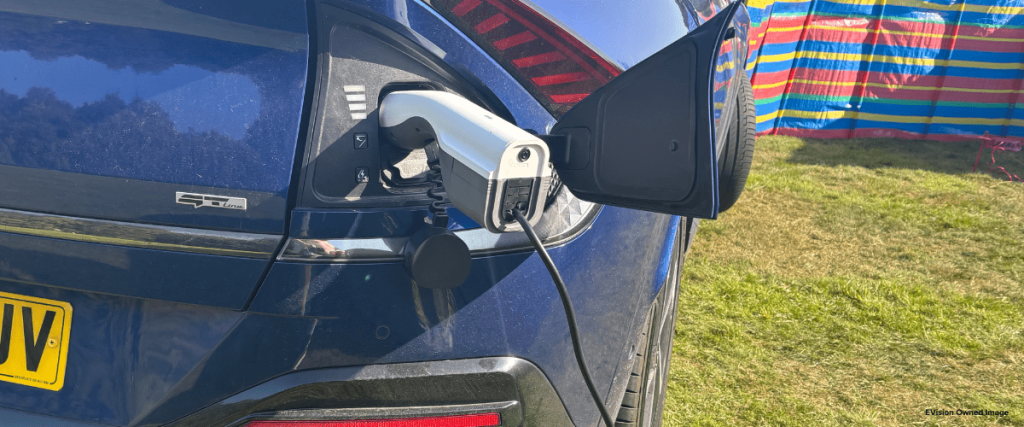
This past weekend, I had the opportunity to use the vehicle-to-load (V2L) feature on my Kia EV6. It wasn’t planned, but it certainly gave me the chance to see just how well it works, and what effect it has on the car’s battery. In this post, I’ll share the full experience. Spoiler: it was surprisingly enjoyable.
What Exactly is Vehicle-to-Load (V2L)?
Vehicle-to-load (V2L) is a technology that allows an electric vehicle (EV) to supply power to external devices, appliances, or even another vehicle. Drawing from the EV’s battery, V2L can deliver alternating current (AC) electricity via dedicated sockets or adaptors, much like a standard mains outlet.
This feature comes into its own during power cuts, camping trips, or outdoor events, where it can run everything from kettles and lights to laptops. Some systems can provide several kilowatts, meaning they can power larger equipment too.
Unlike vehicle-to-grid (V2G), which returns energy to the national grid, V2L powers local devices directly, offering convenience, flexibility, and resilience for both day-to-day use and emergencies.
This is, of course, a relatively new feature, something you’d never find on a traditional petrol or diesel car. In fact, it’s still not standard across all EVs. However, several models in the EVision fleet do have it, including the MG ZS, Hyundai Ioniq 5, and Kia EV6.
My Experience
On Saturday, as we set off for our annual family camping trip, the car was packed with all the usual gear: an electric cool box, camping lights, and various chargers. My wife and I expected the campsite to have an electric hook-up, allowing us to power everything as normal.
However, when we arrived, it became clear there wasn’t so much as a single socket in sight. A quick text exchange confirmed it, we’d be going without.
While weighing up our options, my eyes fell on the Kia EV6. A lightbulb went on in my head, quite literally in this case, given what followed. The answer to our power problem was sitting right in front of me.
I’d only ever used V2L briefly before, just to test it, but I was confident it could handle everything we needed for the next two days. This would also give me the perfect chance to see how much impact it would have on my range.
An Experiment Unfolds
I started my V2L trial just before 5pm on the Saturday. I plugged in an extension lead and connected several items, including the electric cool box, an iPad, an iPhone, and a few other devices. The dashboard showed a healthy 80% charge. The question was: how much would it drop?
By the end of the evening, the battery had only gone down by 2%. The next day, I checked in periodically, and by 5pm on Sunday, just 5% had been used. When it came time to pack up on Monday morning, the dashboard still showed 72% remaining.
In other words, powering our entire campsite for two days had only used 8% of the battery. I was genuinely impressed.
Testing V2L in an Emergency
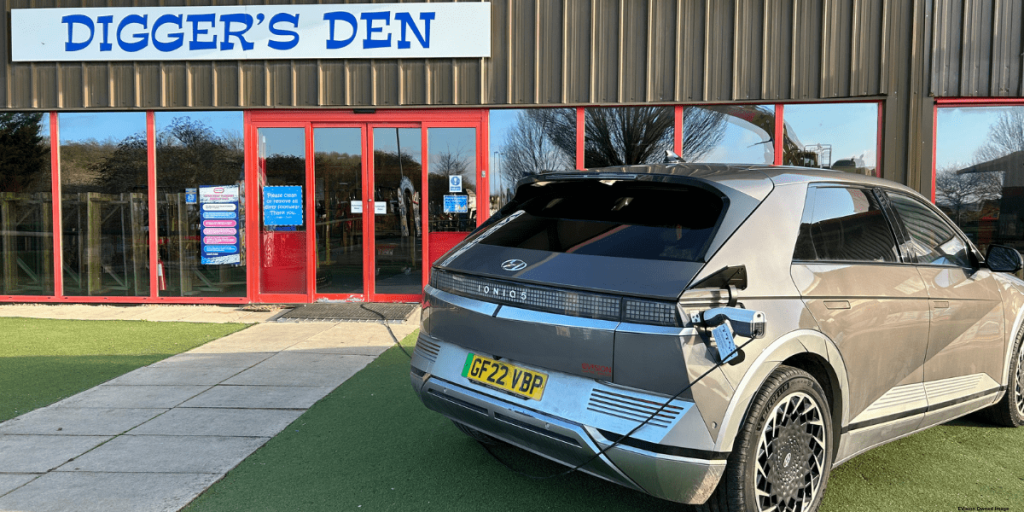
This wasn’t EVision’s first experience with V2L. A couple of years ago, our sister company, Diggerland, suffered a power outage. On that occasion, the Hyundai Ioniq 5’s V2L capability kept the lights on for several hours.
These are just two examples of how useful this feature can be. You never know when you might need a little extra help in the power department, but it’s reassuring to know it’s there.
In Summary
Electric vehicles are a completely different breed from what came before, and new features are emerging all the time. The V2L function is just one example, but as my experience shows, it’s one that can prove invaluable.
You may not use it often, but when the time comes, you’ll be glad you have it.
*All information correct as of 26 August 2025
Don’t forget to follow us on social media to stay up to date with the latest EV news and special offers:
Facebook: https://www.facebook.com/EVisionEVs/
X: https://twitter.com/EVisionEVs
Instagram: https://www.instagram.com/evisionevs
TikTok: https://www.tiktok.com/@evisionelectricvehicles
LinkedIn: https://www.linkedin.com/company/evision-electric-vehicles/